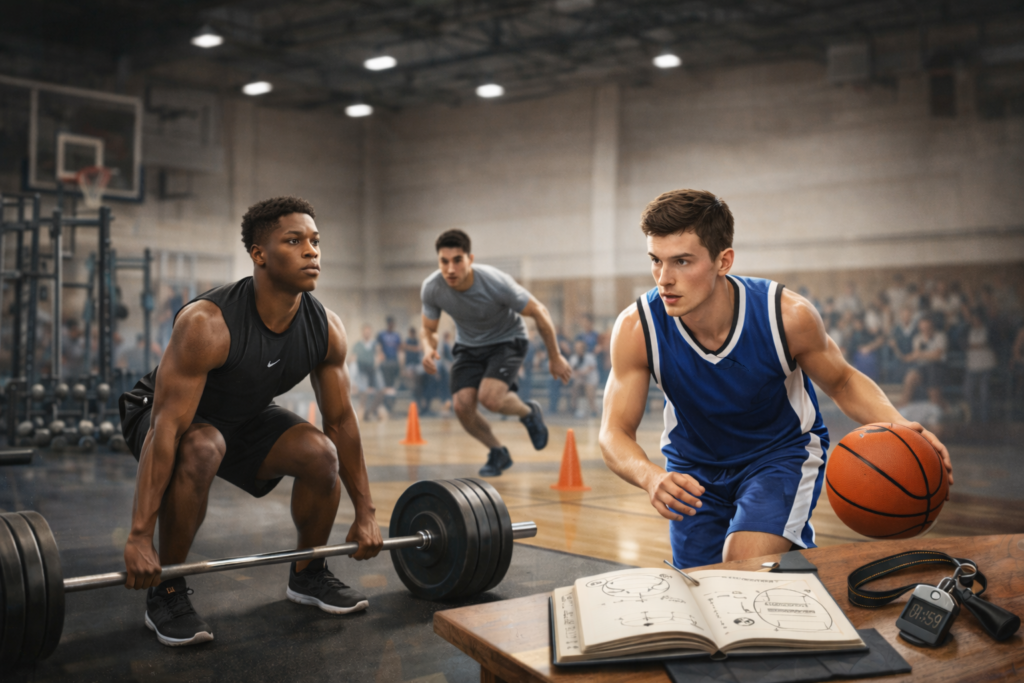
Many parents believe basketball IQ is something athletes are naturally born with. While some players may pick up concepts faster than others, basketball intelligence can actually be developed through physical performance training.
Strength and speed training improves how quickly an athlete’s body can react to situations on the court. This directly impacts reaction time, awareness, and decision-making during games.

Speed training helps athletes improve:
First-step explosiveness
Lateral quickness
Defensive recovery time
Closeout speed
These improvements allow players to:
Rotate faster on defense
Recover when beaten off the dribble
React quicker to passes
Create separation on offense
Faster reaction time leads to better decision-making during live game situations.
Athletes who develop strength and coordination gain better control of their movement on the court.
Improved:
Balance
Core strength
Stability
Coordination
Allows athletes to:
Finish through contact
Change direction quickly
Maintain vision while moving
Avoid unnecessary turnovers
Better body control gives players the ability to process the game without losing mechanical control of their movements.
Fatigue often causes:
Turnovers
Late defensive rotations
Poor shot selection
Missed assignments
Well-conditioned athletes are able to:
Stay focused longer
Execute late in games
Maintain defensive effort
Process game situations more effectively
Improved conditioning supports smarter decision-making throughout the entire game.
Training the body improves how quickly the brain can process the game. Athletes who consistently participate in strength, speed, and agility training often develop better basketball IQ over time because they can physically keep up with the pace of competition.